
Author’s Note
This essay is a small prelude to my forthcoming book, Integral Liberty: The Age of Renewal, which I hope to publish before Christmas. It reflects a concern I believe many of us quietly share: that something essential in our interior and civic life has thinned, even as the world grows louder and more chaotic. My aim here is simply to name that drift with clarity — and to point gently toward the path back to depth.
Craig C. Shelton
There are many ways a civilization can lose its footing, but only one way it can lose its grip: by drifting from the ground of Being itself. We speak often of political instability or cultural fragmentation, yet beneath these surface disorders lies a more fundamental detachment — a quiet, unnoticed severing from the ontological structure that once shaped interiority, sanity, and the shared texture of reality. Modernity’s great unexamined choice was to stand not on the ground but on a surface: a flat plane of ontological zero—a state in which nothing is held to be true, and no claim of meaning is felt as binding, independent of feeling.
This essay is an attempt to map that plane, to show what becomes of the inner life when a civilization elects to inhabit it, and to illuminate the psychic cost of that detachment.
To grasp the character of this terrain, it helps to picture not a landscape with features but a surface without contour — a kind of ontological sensory-deprivation tank into which a civilization may enter at will. Inside this chamber, impressions remain, but they are muted, softened, easier to manage; the moral world becomes less demanding because nothing resists, nothing obliges, nothing pushes back. Over time, a civilization chooses to spend more and more of its life in that chamber, drawn by the comfort of an ever-easier moral code, until the dimmed impressions inside begin to substitute for the vivid realities outside — and eventually, no one comes out of the tank at all. On such a surface, consciousness does not lose its faculties; it simply orients itself with progressively thinner feedback, guided more by preference than by recognition, more by projection than by encounter. The result is a slow erosion of contact: a drift away from the frictive, resistant givenness of Being toward a domain where meaning becomes increasingly self-referential and increasingly untethered.
A second analogy may clarify the structure further. Imagine a computer whose operating system still runs but whose BIOS — the foundational layer that mediates between software and hardware — has been corrupted. Programs may continue to execute, windows may still open, processes may still appear coherent, but over time more and more of these operations become ungrounded in the underlying architecture that once guaranteed their stability. What appears as activity is, in truth, no longer computation but a kind of patterned hallucination: signal without contact, form without friction. Life on the flat plane functions in much the same way.
This dynamic can be rendered more precisely by a simple topography. Picture a great bowl whose lowest point represents the full acknowledgment of Being — the domain in which truths have ontological weight and where consciousness is shaped by the frictive contact with reality. Around the rim of this bowl stretches a flat plane: the zone where the classical modern isms positioned themselves, each rejecting the vertical depth of Being in favor of a horizontal world grounded in preference, assertion, or sentiment.
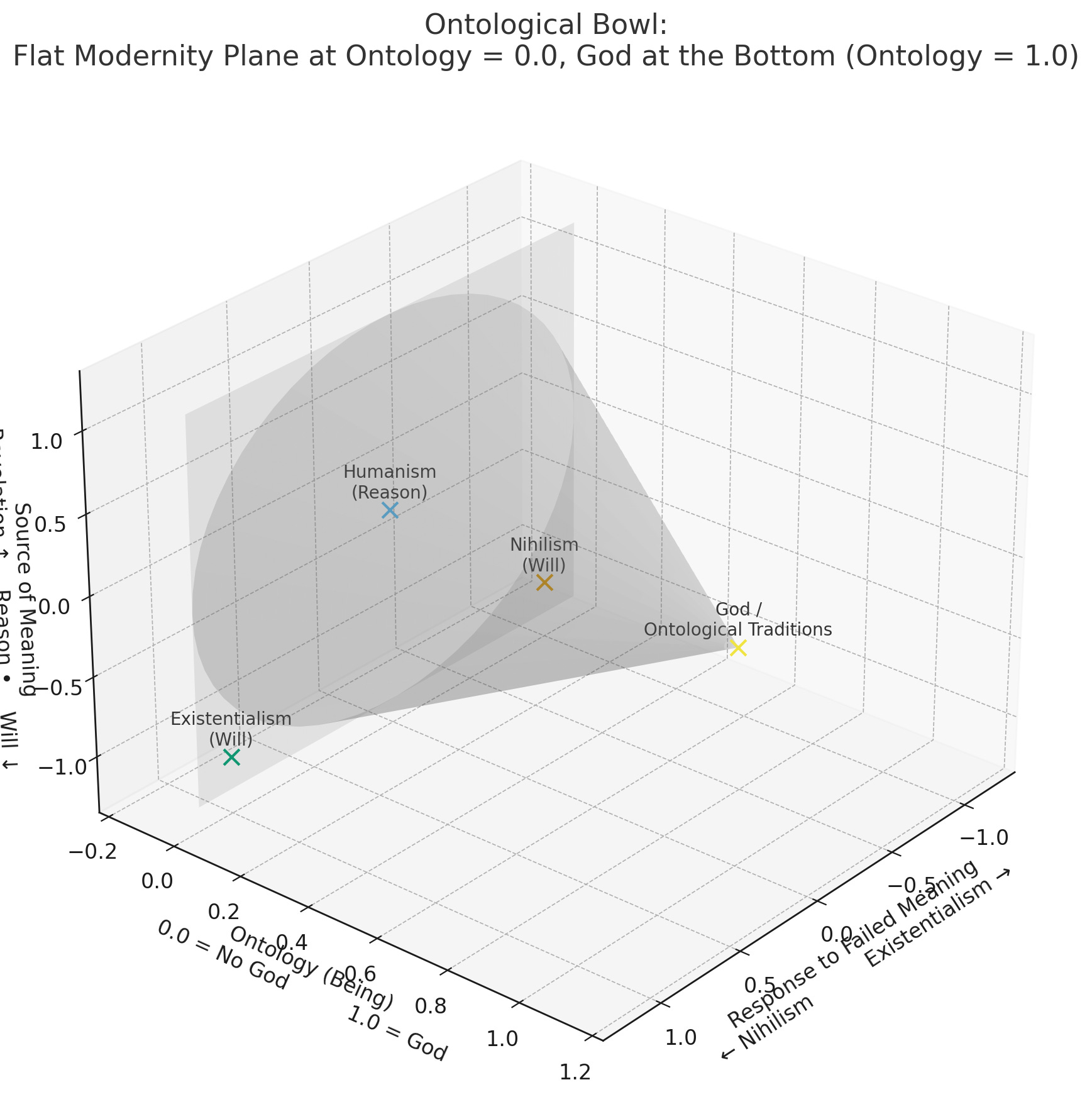
Figure 1. Ontological Hilbert Space
In this map, the horizontal axis represents a worldview’s relation to ontological depth — the degree to which it grants truth any independent weight. The vertical axis represents its response to meaning — how far the psyche allows reality’s claims to register, oblige, or restrain.
The coordinate “0.0; 0.0” marks the point at which both dimensions fall to zero: the first “0.0” indicates no acknowledgment of ontological depth; the second “0.0” indicates no binding response to meaning. It is the double-null point — a flat surface where truth is granted no weight and the psyche encounters no resistance.
To inhabit this plane is not to deny reality outright but to forgo the stabilizing gravity that only ontological truth can provide. In such a space, meaning does not disappear; it merely becomes a function of will rather than recognition, projection rather than contact.
In the diagram, the word “God” functions only as a compact label for something that cannot be printed on a single axis: the cosmological reality of absolute ontological truth. It names the recognition that some features of Being are independent of feeling or preference. In this sense, “God” denotes the upper bound of the ontology and meaning axes — the point where truth is fully real (1.0 on the ontology axis), meaning is received rather than self-generated (1.0 on the meaning axis), and no existential recoil is possible because meaning cannot fail (0.0 on the response-to-failed-meaning axis). For visual reference, this point is expressed as the coordinate (1.0, 1.0, 0.0).
Seen in this light, even certain cultural images take on unexpected clarity. Consider, for instance, the people suspended in The Matrix: their bodies inert, their sensations intact, their impressions real only within the closed system that generates them. They inhabit a plane of sensation without held truth — our “0.0; 0.0” surface — a world whose coherence is detached from the ground it conceals. What the fiction renders dramatically, our civilization has approached quietly: not through coercion, but through a long drift into abstractions that ask less of us with every passing year. And here the crucial question emerges: what becomes of interiority — of consciousness, of self-recognition, of the psyche’s grip on reality — when a people chooses to live on that plane and no longer comes out of the tank at all?
SECTION I — The Ontological Cost
Before turning to the formal mechanism beneath this drift, it is worth pausing to see the shape of the problem plainly. The flat plane is not merely a metaphorical surface; it is a structural condition in which impressions lack friction, meaning lacks weight, and the psyche encounters no resistance strong enough to compel reorientation. A civilization can remain on such a surface for a long time — long enough that the absence of depth begins to feel normal, even natural. But beneath this growing ease lies an unspoken cost: when the mind no longer meets the world as something with claims of its own, interiority begins to reorganize around preference rather than truth, comfort rather than recognition. It is here, at this point of subtle but profound reconfiguration, that the deeper architecture of the self is put at risk.
This is where Shelton’s Ontological Razor becomes indispensable. Without it, the flat plane can appear benign — merely a stylistic preference of a late-modern age. With it, the terrain reveals its true character: not a neutral surface, but a double-null point at which both ontological depth and existential response have been reduced to zero. The Razor shows why such a position cannot remain stable, and why any psyche or civilization that occupies it will, by the nature of things, begin to lose its grip on reality.
Shelton’s Ontological Razor
Shelton’s Ontological Razor uses Gilbert Morris’s axioms:
Ontological: that aspect of existence that is true no matter what you feel.
Existential: that aspect of existence that you feel no matter what is true.
It then applies ‘Archimedes’ lever’ to the truth test:
If even one aspect of existence is true — no matter what you feel — then an ontologically grounded account of absolute truth is possible.
But, if not even one aspect of existence is true, then everything collapses into pure solipsism, and there is nothing left to say of any importance about anything at all.
Applied to the flat plane, the result is stark. A civilization positioned at the coordinate “0.0; 0.0” has not disproven truth; it has merely ceased to grant truth any weight. It refuses the first axiom by declining to acknowledge ontological depth; it refuses the second by declining to feel any binding claim of meaning. In that double refusal, the civilization attempts an impossible feat: to live as though Being were optional. The Razor shows why this cannot hold. Being does not retaliate, but it does exert consequence. The psyche, deprived of real contact, begins to thin; meaning becomes self-generated; interiority loses its orientation; and the civilization that chose the tank finds, too late, that it has eroded the very faculties required to return to the world outside.
SECTION II — The Interior Consequences
If a civilization positions itself on the flat plane long enough, the consequences for interiority follow with quiet inevitability. A self that no longer meets the world as something that pushes back begins to reorganize its inner life around sensation rather than recognition. Meaning becomes not a discovery but a manufacture. Emotional preference, once merely a component of judgment, gradually becomes its whole content. What had been the psyche’s encounter with a world of claims becomes a system of impressions circulating without orientation, purpose, or friction. The self still feels, still decides, still acts — but it does so increasingly without reference to anything outside its own projections.
The first casualty is attention. When truth is no longer granted weight, attention loses its anchor. It flits, accumulates, responds, but it does not dwell. The mind becomes unimpressed by the real because nothing is held to be able to impress it. This thinning of attention is not merely cognitive; it is moral. A culture that dwells on nothing cannot recognize depth even when it is directly present. Judgment, once shaped by the demands of reality, becomes guided almost entirely by immediacy — by what feels urgent, pleasing, threatening, or convenient. What had been discernment becomes preference; what had been conscience becomes mood.
The next casualty is memory. Memory, in a metaphysical sense, is the psyche’s ongoing reconciliation with reality — the internalization of truth over time. But on the flat plane, where truth has no binding force, memory loses this function. It begins to serve the present rather than correct it. The past becomes pliable, selectively recalled to reinforce current feeling. Without ontological weight, memory no longer stabilizes the self; it amplifies it. A civilization that lives this way retains information but loses recollection; it keeps data but forfeits wisdom.
Finally, the deepest casualty is coherence. Coherence is not merely consistency of thought but the lived sense that one’s inner life is answering to something beyond itself — something that has its own independent shape. When a civilization moves onto the double-null point, this answering disappears. The self’s architecture becomes self-referential: it generates meaning, affirms meaning, modifies meaning, and dissolves meaning, all without contact. What results is not chaos but a different kind of order — an order without gravity. The psyche floats, not in freedom, but in suspension. It does not break down; it drifts.
None of these effects are dramatic. They occur gradually, silently, often unnoticed. A civilization can drift into them believing itself healthy, informed, expressive, and free. But beneath that confidence lies an increasingly fragile interiority — one unmoored from truth, unshaped by reality, and unpracticed in resistance. The tragedy is not that individuals become irrational, but that rationality itself becomes unanchored: a tool without a world to answer to.
These are the interior consequences of a civilization that chooses the flat plane. The self continues to function, but it no longer has a world to belong to. And once interiority has been thinned in this way, the drift does not remain private. The pathologies of the inner life begin to shape the public world.
SECTION III — The Civilizational Consequences
When interiority thins, public life will progressively lose coherence. A civilization is not held together by institutions alone but by the interior capacities of the people who inhabit them — the ability to recognize truth, to submit to evidence, to endure moral friction, to perceive depth, and to discriminate between what is real and what is merely wished. When these capacities weaken, institutions begin to deform in predictable ways. They remain standing, they continue to operate, they retain the appearance of authority — but their internal logic begins to mirror the flattened consciousness of the culture that sustains them.
The first consequence is a collapse of shared meaning. Public discourse loses its referent. Words still circulate, but they no longer land on stable realities; they land on feelings, impressions, and momentary alignments of preference. Debate becomes performance; persuasion becomes branding; disagreement becomes pathology. The civic sphere does not become irrational — it becomes untethered. Without a shared ground of Being, there is no longer a common world within which disagreement can be resolved. There are only competing narratives, each calibrated to emotional appeal rather than contact with truth.
The second consequence is institutional self-reference. Institutions that once answered to realities beyond themselves — justice, truth, competence, craft, stewardship — begin to answer primarily to their own internal incentives. What was once an orientation toward the real becomes an orientation toward metrics, outputs, appearances, and reputational safety. Bureaucracies drift into a kind of cognitive autopilot: they behave as though the world they regulate were a projection rather than a structure with its own demands. This is not corruption; it is abstraction. Institutions, like individuals, begin to inhabit the tank.
The third consequence is the rise of pseudo-morality. On the flat plane, where truth no longer binds, morality becomes expressive rather than responsive. It shifts from recognition of the good to signaling of sentiment. Moral language persists, often with great intensity, but it functions as a badge rather than a discipline. Without the friction of the real, moral claims become costless; without cost, they lose seriousness. A civilization that replaces truth-based ethics with preference-based ethics eventually finds that its moral vocabulary inflates even as its moral capacity declines.
The fourth consequence is the political polarization of everything. When a civilization loses the stabilizing weight of ontological truth, politics quietly assumes the role truth once played. It becomes the source of identity, purpose, meaning, and metaphysical heat. Questions that once belonged to philosophy or religion migrate into the political sphere, where they cannot be resolved and thus generate perpetual conflict. The political system is not to blame; it is simply being asked to carry a metaphysical burden it was never designed to bear.
The final consequence is civilizational fatigue. A society without depth gradually loses the ability to renew itself. Its creativity wanes; its confidence erodes; its institutions hollow; its public life becomes reactive and performative. The culture feels increasingly weightless — not because it lacks activity, but because it lacks grounding. A civilization can survive a crisis of resources or power, but it cannot survive indefinitely a crisis of truth. Without ontological contact, the civic imagination cannot regenerate; without regeneration, decline becomes not a choice but a trajectory.
This is the civilizational cost of the flat plane: not chaos, not collapse, but something quieter and more dangerous — a slow draining of meaning from the shared world, until a civilization discovers that its institutions still stand, its rituals still repeat, and its language still circulates, but the inner substance that once animated them has thinned beyond recognition.
SECTION IV — The Return to Depth
If the drift toward the flat plane is gradual, the return from it begins in the same quiet way. No civilization reverses such a trajectory by exhortation or force; it does so by recovering contact with what is real. The first step is not ideological but ontological: to acknowledge that reality has a structure independent of our preferences, and that a life lived in recognition of that structure is richer, more stable, and more humane than one lived without it. This is not a plea for dogma; it is the simple recognition that sanity begins where the world pushes back.
The recovery of depth starts with attention. When a culture regains the willingness to dwell — to look long enough at something for it to disclose its form — the psyche begins to thicken again. Attention is the first organ of truth. It is through sustained perception that the mind re-learns the texture of the real and the difference between what merely feels true and what is true. A civilization cannot think clearly if its attention is shallow; nor can it renew itself if its attention is scattered. Depth of world requires depth of seeing.
Next comes the restoration of memory. Not memory as nostalgia or selective comfort, but memory as the long reconciliation between the self and the real. A society that remembers truthfully regains orientation. It learns again to distinguish between error and recognition, to see its past without distortion, and to judge its present without illusion. Memory is the bridge between interiority and history; when it is restored, the culture recovers not only continuity but responsibility.
From attention and memory arises the rebirth of coherence. Coherence is the inward sense that one’s life, one’s judgments, and one’s acts are answering to something beyond the self. It is what gives integrity its ballast and purpose its clarity. A civilization regains coherence when its people begin to live as though their choices have weight because the world itself has weight. Without acknowledging Being, coherence is impossible; with it, coherence becomes the natural condition of an unfractured interiority.
Finally, a civilization returns to depth by recognizing that contact with the real is not a burden but a gift. Ontological truth does not confine; it liberates. It releases the mind from the exhaustion of self-invention and the anxiety of perpetual self-reference. It anchors judgment, stabilizes the moral life, and restores the possibility of shared meaning. A society that recovers depth recovers the capacity for renewal — not because it finds new slogans, but because it reclaims the world that had been there all along.
The return from the flat plane is not a revolution. It is a reorientation — a turning toward the ground of Being with the quiet understanding that nothing in public or private life can flourish without it. Civilizations do not heal by will alone; they heal when the mind re-enters the world it inhabits, and the world re-enters the mind that recognizes it.
The path back is neither sudden nor dramatic. It begins wherever someone, or some community, chooses reality over preference, truth over comfort, depth over drift. From such small acts of recognition, whole civilizations have found their way home.
Conclusion — The Choice Before Us
The flat plane of modernity was not a catastrophe but a misjudgment — a gradual civilizational wager that we could live well without the grounding force of Being. For a time, the wager appeared to succeed. Life grew easier, friction lessened, and the demands of truth seemed optional. But ease is not stability, and preference is not recognition. A civilization that reorganizes itself around sensation rather than contact will, in time, feel the consequences in its inner life and its public life alike.
This essay has traced those consequences — the thinning of interiority, the weightlessness of meaning, the abstraction of institutions, and the quiet exhaustion that settles over a culture when truth no longer anchors its imagination. None of this occurs suddenly. Decline does not announce itself; it accumulates. What collapses first is not structure but depth, not order but orientation, not reason but the world reason was meant to answer to.
Yet the way back is neither dramatic nor obscure. It begins with the simplest act a civilization can undertake: the willingness to let the real make its claim again. That requires no ideology, no program, no new doctrine — only the recognition that truth is not an enemy of freedom but its precondition; not an imposition, but the ground on which all meaningful life stands.
The choice before us is therefore not between past and future, nor between one political alignment and another, but between drift and depth — between a civilization suspended on the flat plane and one re-anchored in the structure of the real. Every generation must choose which world it will inhabit. Our age is no different, except perhaps in this: we now know what the flat plane costs.
To return to depth is to return to sanity — not by force, but by recognition. And once a culture remembers what it is to meet the world as something with claims of its own, renewal becomes possible again. The ground of Being has not moved. Only we have.
And we can choose to stand upon it once more.